Resistance training is not just for building bigger muscles. Resistance training benefits include the prevention and management of cardiovascular disease, cancer, and diabetes. Studies show resistance training reduces blood pressure, alleviates depression, and improves sleep quality. Resistance training is essential for maintaining a great quality of life.
Resistance training can be lifting free weights, using stretch bands, doing pushups or just simply getting up and down out of a chair. Resistance training is simply working your muscles against resistance.
Resistance training benefits people of all ages.
The American College of Sports Medicine (ACSM) has updated their guidance on resistance training. The 2026 guidelines build on and update the last set of guidelines that were released in 2009. Since that time a tremendous amount of research has been done.
The 2026 guidelines were drafted by multiple authors who took the approach of doing a synthesis of previously done systematic reviews and meta-analysis. A “systematic review” or “meta-analysis” presents results by combining and analyzing data from different studies conducted on similar topics. A good systematic review starts out by clearly defining what questions they want answered, how they are going to gather the studies on the subject, what criteria they will use to include or exclude the studies and how they will go about analyzing the results. BEFORE they start the review, they publish these methods in official registries – that way they can’t just change how they are doing the studies in the middle if they don’t like the preliminary results. A well done meta-analysis also employs standardized tools to grade the level of evidence, potential biases, and other factors. These tools are also part of the methods they publish before the study.
The group from the American College of Sports Medicine identified 137 systematic reviews that sought to answer the questions they had set out to answer. They used rigorous methods to evaluate and report their findings. The questions they were looking to answer included topics including: what frequency a person needs to do resistance training to maximize their muscle size and strength gains, as well as how to best improve functional outcomes such as walking, balance and climbing stairs.
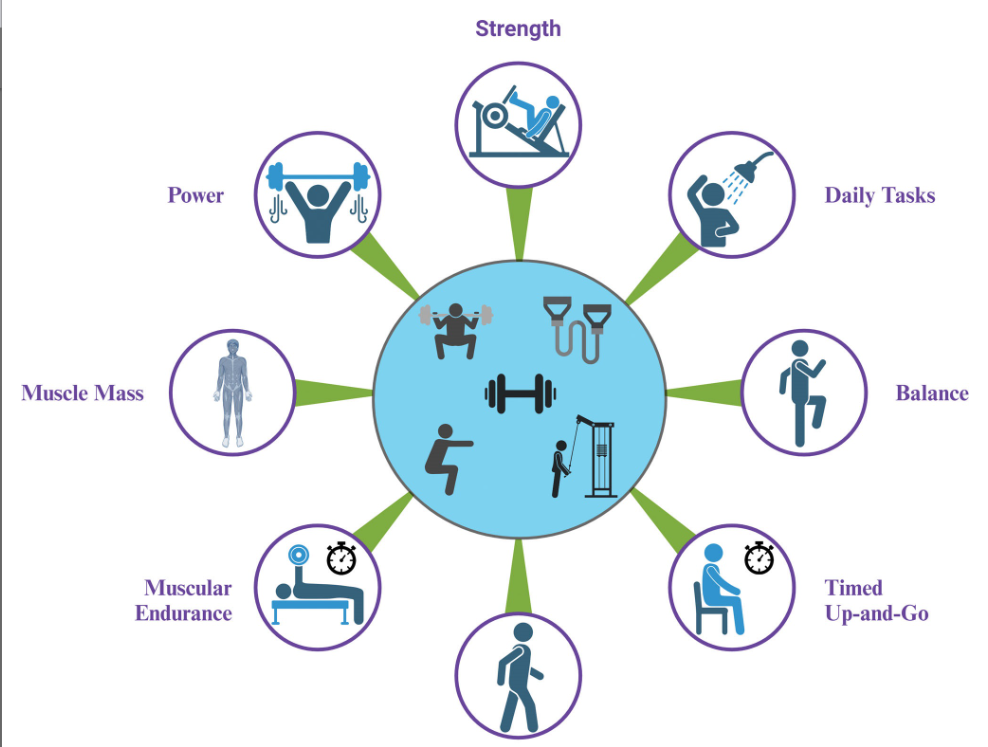
This overview of reviews was intended to put together practical evidence-based guidance for a general population of healthy adults. If you are interested in the nitty gritty details of the study, click here for the 21-page main article (there are additional links to multiple digital appendices – way more than 21 pages).
Here are some of the main points from the report (and other sources):
1. Adults benefit from resistance training! Almost everyone can and should do resistance training. Certain medical conditions may alter the specifics of what a person should do for resistance training. Best to talk to your primary care provider if you think you have a condition that would limit what you can do.
2. There are many forms of resistance training. You do not need to join a gym to get started. If you are new to resistance training just getting up from a chair while holding a 3-pound bag of onions repeating that until you have worked the muscle near exhaustion is resistance training.
3. The most important part of resistance training is doing it regularly. Once a week is better than not at all. Twice a week is better than once a week. Here is what I do: I work each major muscle group against resistance about every 72 hours (between hard sessions) (I do various “cardio” sessions several times a week as well).
4. The optimal plan for each individual is dependent on their goals. A younger person with the primary goal of attracting a mate may want to pursue a different program from an older person wanting to stay out of the nursing home. However; the plan does not need to be complicated, especially for the person just getting started.
5. To gain strength your focus is on lifting heavier loads. For getting bigger muscles the volume of work that you do over a week is important. To train for power; which is moving heavy things fast, you lift moderate weight fast (just during the “lifting” part of the exercise – for example going up from a squat position, when you go back down, do so always in a slower controlled motion).
6. Bottom line: body builders, power lifters, and competitive athletes may benefit from some advanced programs. But most of us just need to do resistance training – of some sort. At least twice a week; work moderately hard, all major muscle groups. You don’t need to spend hours in the gym – an hour a week of resistance training can make a big difference in your quality of life (one study suggests that 90-120 minutes a week may be the “sweet spot” for longevity).
A personal trainer or other professional may be a great investment; but if that is not something you want to do, there are plenty of resources to get you started and keep you going. Check out my list of resources below. If you are already doing some resistance training I have provided in my list of resources some places to go to learn more.
If you are my patient and want to learn more about how exercise can help you prevent or control chronic conditions – please make an appointment.
Go here for an infographic from The American College of Sports Medicine on how to develop a resistance training plan. Click on the image to download it as a PDF that you can print out.
Click here for some extended discussions on these guidelines – a 50 minute interview with the senior author of the report.
Click here for a collection of “Resistance Training Resources for Everyone!” and here for “Fitness and Sports Medicine Resources”.
These resources and other information are presented for education, they are not intended as medical advice. Almost everyone can and should participate in some form of resistance training. It is rare for someone to be unable to participate in resistance training, but there may be cardiac or other conditions that restrict certain activities. For more information on resistance training and cardiovascular disease see this statement from the American Heart Association.
If you have significant orthopedic issues, your primary care provider might refer you to a physical therapist for exercise guidance. If you haven’t been active for a while, are older, or have a chronic health condition, it’s wise to consult your primary care provider.
Click on the links below for a couple sets of resistance training routines that are suitable for most everyone.
4 Resistance Training Movements to Do at Home Without Equipment
See also my article on “Higher Protein Diet plus Resistance Training effects on Fat Loss and Saving Muscle”.
Check out as well a few of my other articles on fitness
Physical Activity is a Medical Therapy
All Ages Benefit from Physical Activity
healthmatters.fitness/uncategorized/all-ages-benefit-from-physical-activity/
Training 4 Life: 9 Adaptations
Training 4 Life: 9 Adaptations
http://healthmatters.fitness/uncategorized/training-4-life-9-adaptations/
Training 4 Life: 9 Adaptations: Long Duration Endurance
http://healthmatters.fitness/uncategorized/training-4-life-9-adaptations-long-duration-endurance/
Training 4 Life : 9 Adaptations : Resistance Training for Muscle Mass, Function, AND Quality of Life
Living an Active Life
Living an Active Life : Getting Out and Experiencing the Wonders Around Us
“There are no easy Fourteeners”
http://healthmatters.fitness/uncategorized/there-are-no-easy-fourteeners/
Exercise Planning and Programing
Exercise Planning and Programing: Inspiration, Motivation, Discipline, Habit, and Passion
Exercise Planning and Programing: Planning and Logging Your Fitness
Exercise Planning and Programing: Planning and Logging Your Fitness
See also my recent articles on the removal of the black box warnings on HRT and the effects of combining a higher protein diet and resistance training on preserving muscle while losing fat.
See this video for a great display of sportsmanship.
Russ
Pingback: Warnings Removed on Hormone Replacement Therapy – Health Matters
Pingback: Higher Protein Diet + Resistance Training Effects on Fat Loss and Saving Muscle – Health Matters